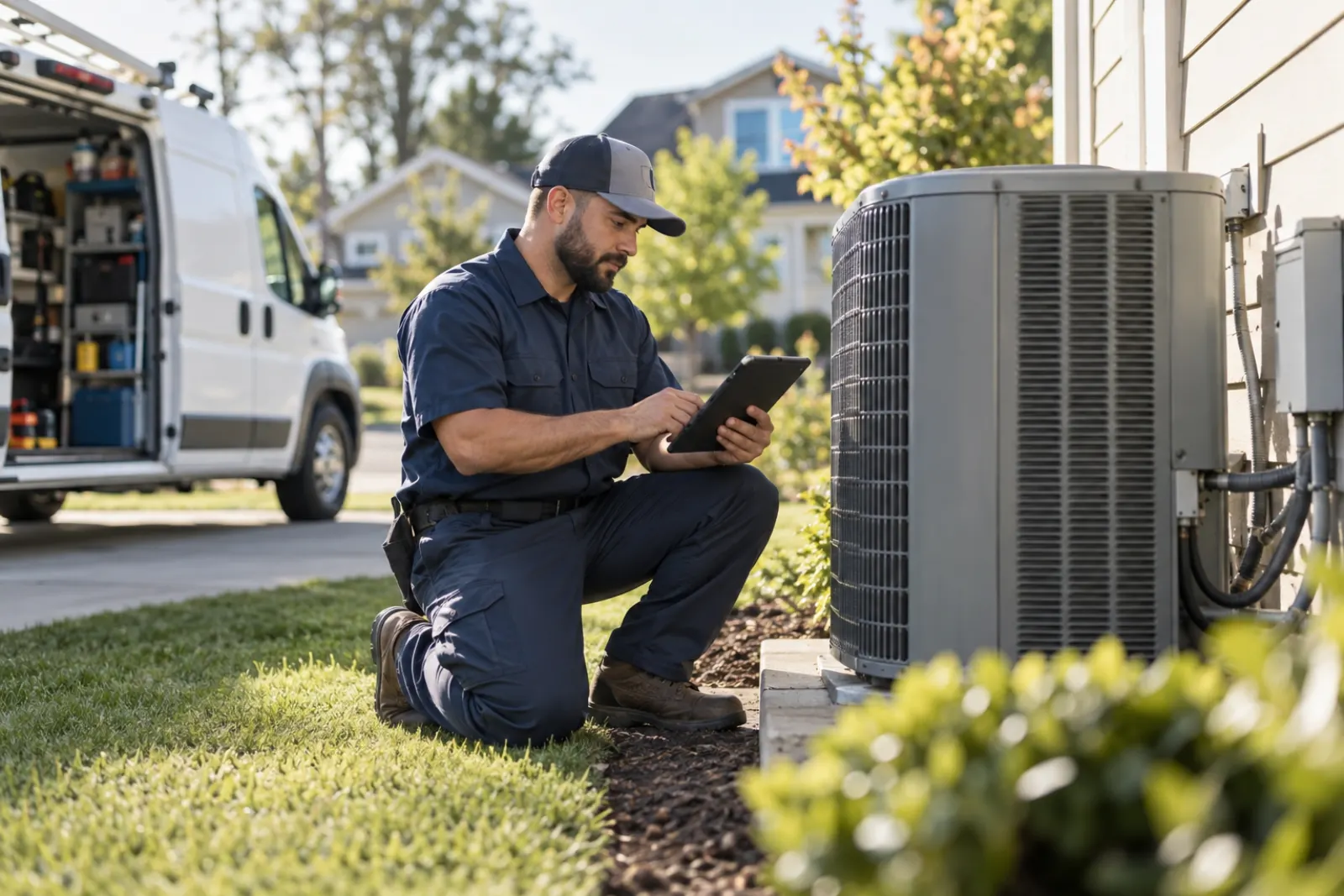
An equipment maintenance tracker keeps one record per machine, vehicle or tool, with its maintenance schedule, inspection checklists, repair history and current status, and it alerts the right person before anything comes due. You can build one without coding by listing your equipment types, the checks each one needs and how often, and who is responsible, then describing that in plain words to an AI platform built for business teams.
Equipment rarely fails without warning. It fails after the oil change was skipped, the inspection was pencil-whipped, or the shop lead who tracked everything in a notebook moved on. For any company that runs trucks, lifts, generators, compressors, kitchen equipment or shop tools, the cost of a breakdown is not just the repair. It is the job you could not do, the crew standing around, and in the worst case, someone getting hurt.
An equipment maintenance and inspection tracker gives every asset one record, with its schedule, its checks and its history in one place, and tells the right person before anything comes due. This guide covers what to include, how to describe it so an AI platform can build it for you, and how to roll it out without burying your crew in paperwork.
What binders and spreadsheets cost you
Most small and mid-size companies track maintenance in some combination of a spreadsheet, a binder of inspection sheets, stickers on the equipment and the memory of one experienced person.
- Nothing reminds anyone. A spreadsheet does not send an alert. If nobody opens it, the service date passes quietly.
- History is scattered. When a machine breaks, you want to know when it was last serviced, what was replaced and whether this has happened before. That information is spread across invoices, binders and texts.
- Inspections become a formality. Paper checklists invite people to tick every box without looking. There is no photo, no time stamp, and no way to tell a real inspection from a rushed one.
- Broken equipment goes back into use. If a failed inspection lives on a sheet in the office, the next person at the machine may never know.
- Audits and insurance questions take days. When an inspector, insurer or customer asks for proof of maintenance, someone has to dig through paper to build it.
What the tracker should contain
The equipment record
Every asset gets the same core fields:
- Asset number and name, such as Truck 14 or Forklift 2.
- Type, make, model, serial number and year.
- Location or assigned crew, and who is responsible for it.
- Meter reading, in miles or hours, where it applies.
- Purchase date and warranty end date.
- Status: in service, due for service, out of service, in repair, or retired.
- Attached documents such as manuals and warranty papers.
- A photo of the asset and its data plate.
Maintenance schedules
For each type of equipment, list the recurring tasks and when they come due. A task can be due by date (every 90 days), by meter (every 250 hours), or by whichever comes first. Each completed task resets the next due date or meter reading automatically. For each task, record:
- What to do, in plain words.
- How often, by date, meter, or both.
- Who usually does it: in-house or an outside vendor.
- Parts and supplies typically needed.
Inspection checklists
Inspections are checklists filled out on a phone at the equipment. Daily pre-use checks on a forklift, weekly checks on a vehicle, monthly checks on a fire extinguisher: each has its own list. For each item, the person marks pass, fail or not applicable. Two rules make inspections real:
- A fail requires a photo and a note.
- A fail on a safety item sets the equipment to out of service until a manager reviews it.
Work orders and repair history
When something fails or breaks, a work order captures the problem, who reported it, priority, who is fixing it, parts used, cost, time spent and when it went back into service. Closed work orders become the repair history on the equipment record. Over time this tells you which assets cost the most to keep running.
Statuses at a glance
| Status | What it means | What happens next |
|---|---|---|
| In service | Safe to use, nothing due | Normal use |
| Due soon | A task comes due within your warning window | Responsible person is reminded |
| Overdue | A task is past due | Manager is alerted, task stays at the top of the list |
| Out of service | Failed a safety check or reported broken | Cannot be assigned until cleared |
| In repair | Work order open | Status returns to in service when the work order closes |
| Retired | No longer in use | Kept for history, hidden from daily lists |
Roles
- Operators and technicians see the equipment they use, complete inspections, and report problems.
- Shop lead or fleet manager sees all equipment, manages schedules, assigns and closes work orders, and clears out-of-service items.
- Office or purchasing sees work orders and parts, and records vendor invoices and costs.
- Owner sees everything, including cost reports.
Notifications
- The responsible person is reminded when a task is due soon, again when it is due, and the manager is told when it is overdue.
- The shop lead is alerted the moment any safety item fails or anyone reports a problem.
- A weekly summary lists what is due in the next two weeks, what is overdue, and what is out of service.
Reports
- On-time maintenance rate: tasks completed by their due date, by month.
- Overdue tasks by asset and by responsible person.
- Out-of-service time per asset.
- Repair cost per asset, so you can see which ones to replace.
- Inspection completion: how many scheduled inspections actually happened.
Questions to settle before you build
- What counts as an asset? A truck clearly does. A cordless drill might not. A useful line: track anything that needs scheduled service, a safety check, or costs enough that you would want its repair history.
- Who is responsible for each asset? A named person, not a crew. When a crew changes, the responsibility moves deliberately.
- What is a safety item? Brakes, lights, guards, alarms and anything that can hurt someone if it fails. Mark these clearly, because they change the equipment's status when they fail.
- How are outside vendors recorded? If a dealer services your trucks, decide whether the shop lead enters their work or the vendor's invoice is attached to the work order.
- What warning window do you need? Seven days is common for in-house work. Work that needs a vendor appointment or parts on order may need two to three weeks.
Settling these first keeps the tracker consistent from day one, and consistency is what makes the reports worth reading.
Example request
Example request: "Build an equipment maintenance tracker for our landscaping company. We have about 60 assets: trucks, trailers, mowers, skid steers and handheld equipment. Each asset has an asset number, name, type, make, model, serial number, year, assigned crew, responsible person, meter reading in miles or hours, purchase date, warranty end date, status, a photo and attached documents. Each asset type has recurring maintenance tasks due by date, by meter reading, or whichever comes first; completing a task sets the next due date. Each asset type also has an inspection checklist; trucks have a daily pre-trip check, mowers a weekly check. Each item is pass, fail or not applicable, and a fail requires a photo and a note. A fail on any item marked safety sets the asset to out of service until the shop lead clears it. Anyone can report a problem, which creates a work order with priority, assigned mechanic, parts used, cost, time spent and closed date. Remind the responsible person 7 days before a task is due, and alert the shop lead when anything is overdue or fails a safety item. Send the shop lead a summary every Monday. Show a report of repair cost per asset per year. Each asset gets a QR code that opens its record on a phone. Roles are owner, shop lead, office and crew member. Only invited people can sign in."
How to roll it out
- Inventory first. Walk the yard and list every asset with its number, serial and meter reading. Take a photo of each one. This is the slowest step and the most important.
- Start with your highest-risk equipment. Vehicles, lifts and anything that can hurt someone if it fails. Get their schedules and inspections right first.
- Write schedules from the manuals and from experience. Use the manufacturer's service intervals as a starting point, then adjust based on what your shop lead knows about how you actually use the equipment.
- Label everything. Put a QR label on each asset so anyone can open its record from a phone.
- Run it with one crew for two weeks. Have them do every daily inspection in the app and report every problem through it.
- Fix friction. If daily inspections take more than a couple of minutes, cut items that do not matter.
- Expand to all crews and stop the paper. Once one crew is consistent, roll out to everyone and retire the binders.
- Review monthly. The shop lead reviews the overdue list and the cost report every month.
Mistakes to avoid
- Inspections that are too long. A forty-item daily check will be ticked without looking. Keep daily checks short and save the detail for monthly ones.
- No consequence for a failed safety item. If a fail does not change the equipment's status, broken equipment stays in use.
- Schedules nobody owns. Every task needs a responsible person, or every reminder goes to everyone and nobody acts.
- Ignoring meter readings. If maintenance is due by hours but nobody records hours, the schedule is fiction. Make the meter reading part of the weekly check.
- Tracking only what breaks. The value comes from the scheduled work. A tracker that only logs repairs is a history book, not a prevention tool.
How to measure that it works
Compare these to the three months before launch:
- On-time maintenance rate.
- Unplanned breakdowns per month.
- Out-of-service days per asset.
- Repair cost per asset.
- Time needed to answer an audit or insurance request for maintenance records.
A rising on-time rate followed by falling breakdowns is the pattern you want. If breakdowns do not fall, look at which assets break most and whether their schedules are right.
Launch checklist
- Every asset is listed with number, serial, meter reading and photo.
- Highest-risk equipment has maintenance schedules and inspection checklists.
- Safety items are marked, and a fail sets the asset out of service.
- Every task has a responsible person.
- Reminders, overdue alerts and the weekly summary are on.
- QR labels are on the equipment.
- One crew has used it for two weeks and their feedback is in.
- The paper binders have a retirement date.
How FORGE handles it
On FORGE, your shop lead or operations manager describes the tracker in plain words, like the example above, and FORGE builds it. A panel of top AI models plans the tool, a dedicated AI crew builds it, and every piece is checked for quality and security before it is saved. Most teams have their first real tool the same day, and the same tracker works on a phone in the yard and a computer in the office.
Your equipment records, inspection photos and repair costs stay inside your company. People join only by invite, each role sees what it should, and there is a complete record of who did what, which is exactly what you want when someone asks who cleared a machine. Crew members who only do inspections are free; builders are $49 a seat a month with 3 builds included, and changes like adding a new checklist cost a small fraction of a build. We onboard every team ourselves, starting with a workflow workshop. Talk to us or see pricing.
Questions people ask
What is preventive maintenance?
Preventive maintenance is service done on a schedule, by date or by hours of use, before something breaks. Oil changes every set number of hours, filter changes every quarter and annual inspections are all preventive maintenance.
Should maintenance be scheduled by date or by hours?
Use whichever matches how the equipment wears. Vehicles and engines usually wear by miles or hours, while safety equipment and fire extinguishers are usually inspected by date. A good tracker supports both and uses whichever comes first.
What is the difference between an inspection and maintenance?
An inspection checks condition and records what was found. Maintenance is the work that keeps equipment running, such as servicing, replacing parts or adjusting. Inspections often create maintenance work when something fails.
How do we stop people from using broken equipment?
Give every piece of equipment a status, and make a failed safety item set it to out of service automatically until a manager clears it. Everyone checking out or assigning equipment should see that status first.
Do we need a QR code on every machine?
It helps a lot. A label that opens the equipment record on a phone means the person standing at the machine can see its history and log an inspection in seconds, without searching.
Who should own the maintenance tracker?
One person, usually a shop lead, fleet manager or operations manager. They keep schedules current, clear out-of-service items and review the reports. Without an owner, schedules drift.
See what FORGE builds for your team
We onboard every team ourselves, starting with the work that costs you the most time.
Talk to us